Articles /
IRONMAN and 70.3 bike power: how many watts should you ride? Setting your IF and pacing the climbs
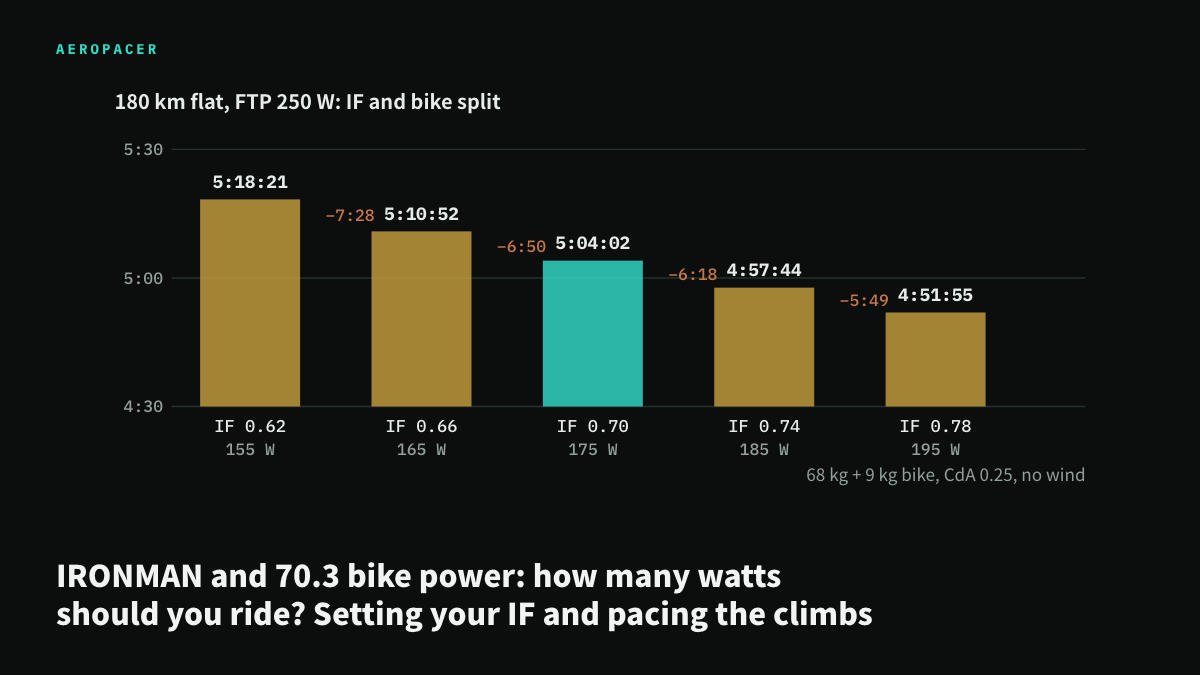
An athlete with an FTP of 250 W, riding 180 km on a flat road with no wind, takes 5 h 4 min at an IF of 0.70. Push the IF up to 0.74 and that drops to 4 h 57 min 44 s. Ten more watts buys a little over 6 minutes.
Now look at those 6 minutes from another angle. If they leave you unable to hold on late in the marathon, and you walk 3 km, dropping from 5:30 per km to 10 minutes per km, those 3 km alone cost you 13 and a half minutes. This is exactly where a lot of people get the math wrong when pacing the bike leg of a full distance.
What is IF?
IF (Intensity Factor) is the normalized power, NP, of a ride divided by your FTP. FTP is roughly the power you can hold for an hour, so an IF of 1.00 is the intensity of a one-hour time trial, and an IF of 0.70 means you are riding at 70% of your FTP.
NP is used instead of average power because riding with surges is more tiring than riding steadily. Take the same 200 W average: ride half the time at 150 W and half at 250 W, and your NP comes out at around 217 W, which is also closer to what your body feels.
What IF should I aim for?
The IF you can sustain depends on how long you ride: what you can hold for two and a half hours and for five and a half hours are very different. So even in the same full distance, an athlete riding 4 h 30 min and one riding 6 h should not use the same IF. Here are the ranges AeroPacer recommends based on your predicted bike split:
| 70.3 bike split | Recommended IF | Full-distance bike split | Recommended IF |
|---|---|---|---|
| 2:15 | 0.82–0.86 | 4:30 | 0.70–0.74 |
| 2:30 | 0.81–0.85 | 5:00 | 0.69–0.73 |
| 2:45 | 0.79–0.83 | 5:30 | 0.67–0.71 |
| 3:00 | 0.78–0.82 | 6:00 | 0.66–0.70 |
| 3:30 | 0.76–0.80 | 7:00 | 0.64–0.68 |
This table already accounts for the run you still have to do after the bike, so the full distance comes out a notch lower than a time trial of the same length. Which end of the range to lean toward depends on three things:
- Your first race at this distance, or not enough long training rides: lean toward the low end.
- A very hot race: your heart rate drifts higher at the same power, so lean toward the low end too.
- The run is your strength: if you plan to make up ground on the run once you are off the bike, there is even less reason to overspend on the bike leg.
One thing matters more than the numbers in the table: your FTP itself has to be accurate. Overestimate your FTP by 5%, and the IF you ride by the table is really 5% higher, so 0.70 in a full distance becomes 0.735. Ideally, use an FTP tested within the month before the race.
What is an extra 0.04 of IF really worth?
From 0.62 to 0.78, each extra 0.04 buys roughly 6 to 7.5 minutes, and less the higher you go, because air resistance rises with the square of speed, so a growing share of the extra power goes into pushing air.
So the few minutes you gain by riding harder on the bike have to be weighed against the run. The marathon in a full distance is run on the fatigue you built up on the bike, and the extra effort you spend on the bike usually gets paid back with even more time once you are off it. Take 6 minutes on the bike and give back 13 walking on the run, and however you do the math, it is a bad trade.
Why not ride the same power the whole way?
IF sets the intensity for the whole race. It does not say every section has to be ridden at the same wattage. On a rolling course, pushing a bit harder on the climbs and a bit easier on the descents is faster at the same NP.
The reason is how your time is split. You climb slowly, so you spend more than twice as long on the climb as on the descent, and every extra watt there buys more seconds. On the descent you are fast and air resistance is high, so most of any extra watts get eaten by the air and buy very little speed. So at the same NP, moving effort from the descent to the climb makes the whole section faster.
There is a limit to this. Ride the climbs too far above FTP and the fatigue comes back to bite you in the second half, so keep the extra effort in check, and hold back more the longer the climb. AeroPacer's race plan splits power into six levels and gives each climb its own wattage based on its grade and length, then lets you choose between three climbing strategies: Conservative, Standard and Aggressive. Steep descents get a separate cap, because on grades like that you can barely put out power anyway.
Should you ease off in the last few kilometers?
Yes. In the last few kilometers before T2, bring the intensity down to let your heart rate and legs settle, so you can actually run that first kilometer off the bike. Easing off for these few kilometers usually costs only 20 or 30 seconds, and you get them back once the first kilometer of the run goes smoothly. AeroPacer's race plan builds this section in automatically.
Taking the numbers into the race
Once you have your target IF, there are two numbers to watch on race day: the power for each climb, and your NP for the race so far. The first 30 minutes are when it is easiest to go too hard, since your legs are at their freshest and everyone around you is pushing, so err on the low side then.
Pick your course in AeroPacer, enter your FTP, weight and CdA, and the race plan works out a recommended IF from your predicted time, sets the power for every section, and exports it as files you can see on your head unit. If you only want to work out speed and time on a flat road first, use the CdA calculator.
Back to those 6 minutes at the start. They are real: on 180 km of flat road, an extra 0.04 of IF is that much faster. How much the run takes back is something no table can tell you. Only your training can show you how much you can hold.
Further reading: How accurately does AeroPacer calculate your bike split?, Which IRONMAN courses are fastest?