Articles /
What is CdA? Why your drag area decides most of your bike leg
Let me start with my own race. In May 2026 I raced a full-distance triathlon in Vietnam (226 km: 3.8 km swim, 180 km bike, 42 km run). Before the race I estimated my CdA by looking up my riding position in a table, and used it to work out how long the bike leg would take. When I checked the prediction against the result, it was off by 8.1%.
After the race I ran the numbers again with the CdA worked out from my other races, and the error shrank to 3.6%. Same course, same power, and only one number swapped out. (Using the CdA worked out from the Vietnam race itself takes it down to 1.9%, but that is checking the answer against itself. All it shows is that the physics model is not off.)
That number is CdA.
What exactly is CdA?
CdA, also known as drag area, is your drag coefficient (Cd) multiplied by your frontal area (A). The unit is square meters. Think of it as how big a patch of air you have to shove aside while you ride. The smaller the number, the faster you go for the same effort.
- Cd is the drag coefficient: how streamlined your shape is, how cleanly it cuts through the air.
- A is the frontal area: the patch of air you and the bike block, seen from straight ahead.
Why does it matter so much? Look at where your effort goes. A 68 kg athlete on a 9 kg bike, pushing 200 W on a flat road with no wind, rides at 37.4 km/h according to the engine. Of those 200 W, 168 W go into pushing air and only 27 W into rolling resistance between tires and road. 84% of your effort is spent fighting the air.
Worse, the power you need against the air does not rise in proportion to speed. It rises with the cube of speed: go 10% faster and the power it takes to push the air goes up by 33%.
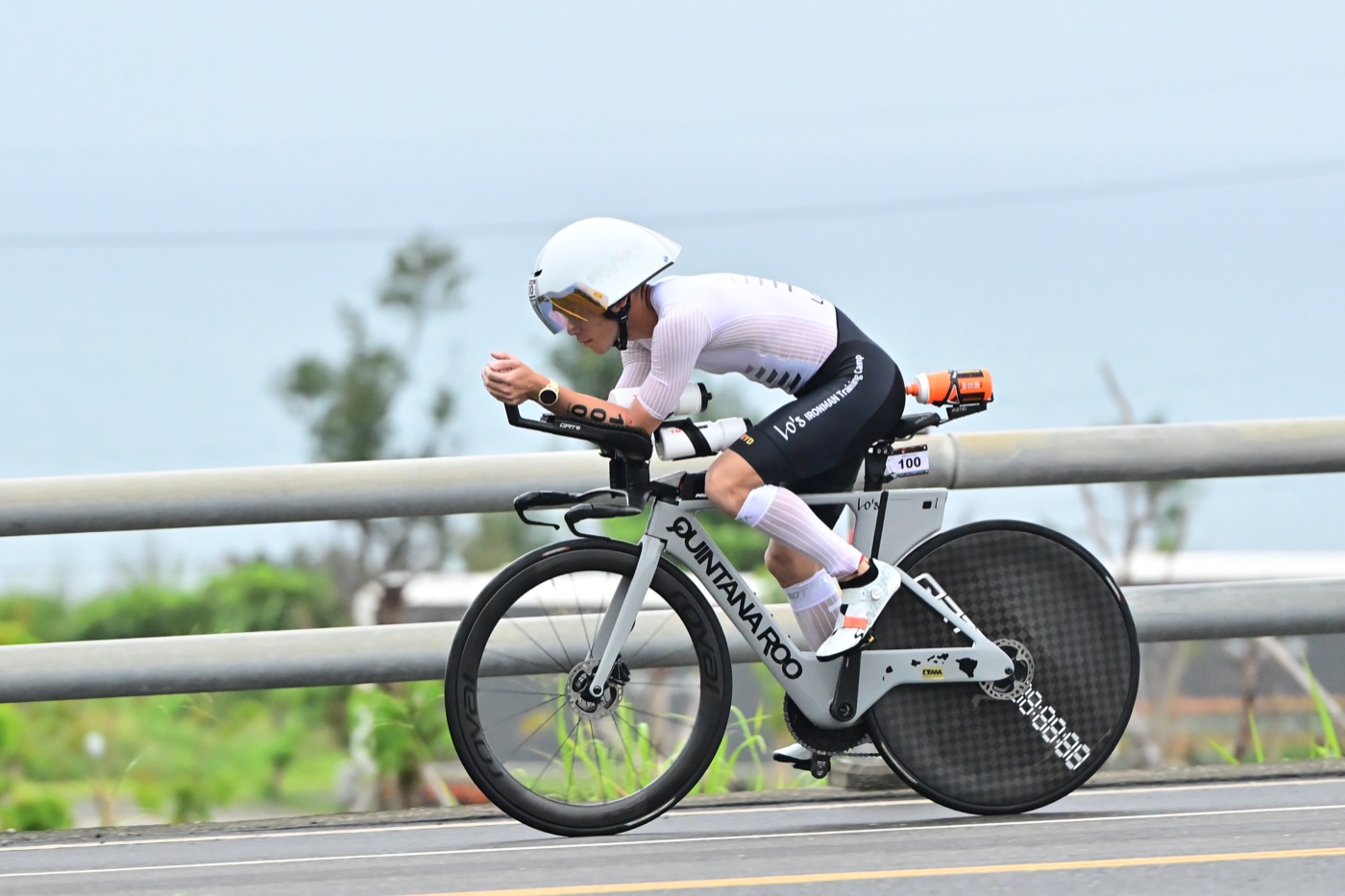
Typical numbers look like this: a Tri/TT bike with an aero helmet is around 0.25, a road bike with clip-on aero bars about 0.285, a road bike in the drops about 0.32, and on the hoods it jumps straight to 0.40. Those values assume a rider of 175 cm and 72 kg. The bigger you are, and the higher you carry your upper body, the higher the number goes.
How much time is 0.01 worth?
Run it through the engine and see. Same athlete, a constant 200 W, 90 km of flat road, no wind:
Going from 0.25 to 0.22 on a Tri/TT bike saves about 6 min over 90 km. A new helmet, lowering your aero bars a little, or moving a bottle from the frame to behind the saddle can get you there, and your FTP does not have to go up by a single watt.
Why isn't a lookup table enough?
A table can only tell you roughly where riders in a position like yours tend to fall, and that range is about ±15%. In bike split terms that works out to roughly ±5%, or about 15 minutes in a full-distance race. That is exactly where my 8.1% in Vietnam came from: my real CdA was well below the table value, so the engine had me slower than I really was.
There are only two places to get a number that is truly yours.
One is a wind tunnel, a lab that blows air straight at you and measures the drag on the spot. An athlete who has gone 8 h 17 min over the full distance measured 0.212 in the wind tunnel at the Hong Kong University of Science and Technology in January 2026.
The other is working it out from your own race file. AeroPacer took the same athlete's power file from IRONMAN Hamburg six months later and got 0.214, only 0.8% off the tunnel. A wind tunnel takes booking and money. The power file you already have.
How do you get CdA out of a power file?
The principle is a power budget. Every watt you put out has to go somewhere: climbing, rolling resistance, acceleration, and pushing air.
Your head unit has already recorded your power, speed and grade every second. Air density comes from that day's temperature and air pressure. Rolling resistance comes from your tire model. Subtract climbing, rolling resistance and acceleration, and what is left is the power spent on the air. Work backwards from that and you can solve for CdA.
In practice a few things distort the number, and they are also what we check to decide whether a record can be trusted:
- Drafting. Sitting behind someone cuts aero drag by about 30%, so the CdA comes out artificially low: a flattering number that is not real. Group ride files cannot be used.
- Wind. Ride one stretch into a headwind and another with a tailwind, and the CdA from each will be very different. AeroPacer corrects for this with that day's hourly wind direction, and pairs outbound and return stretches so the wind cancels out.
- Position falling apart. Late in a long race you lift your head, hunch your shoulders, come off the aero bars, and your CdA changes. We split each race into a first and a second half and compare them. If the second half comes out a few percent higher, it usually means you could not hold the position.
- Broken elevation data. Once water gets into the head unit's barometer, the grade is unreliable for the whole ride, and a wrong grade contaminates the climbing term. Files like that are kept for reference but never used to calculate CdA.
A CdA from a single race always carries some error from that day's weather, so you need several. When records are combined, the more accurate ones carry more weight, the average gets steadier, the error range gets narrower, and the result is more reliable than any single estimate.
How do you ride a file you can use?
No race file? That is fine. Ride one training session like this and you will have one:
- Find a flat road on a calm day and ride at a steady speed for 20 min or more.
- Ride the same stretch out and back twice, so the system can pair opposite directions and cancel out the wind.
- Use the same equipment as on race day: helmet, wheels, kit and where your bottles sit are all part of your aero drag.
- Hold your race position the whole way, and do not draft.
Put the number back into your plan, race again, and afterwards upload that day's file for a post-race comparison. Your CdA gets more accurate every time.
My 8.1% in Vietnam worked out to 22 min. Those 22 minutes were not the engine getting the physics wrong. It just did not know me yet.
Further reading: What is a good CdA? lays out the real spread across 8 athletes on the site, so you can see where your number falls.
Courses in this article