Articles /
How do you dial in an aero position? Head, shoulders, elbows, back, and how long you can hold it
Next time you are three hours into a long ride, look down at your shadow on the road.
Is your head tucked in, or lifted up into the wind? Are your shoulders drawn in, or spread as wide as the handlebars? Is your back one smooth line, or bent in sections? Most people have only seen their position in race photos, and usually the ones from the start, when they look their best.
These questions are worth asking because about 80% of the aero drag on the bike comes from the rider. Frame, wheels and components together only account for around 20%. The industry is very good at selling "free speed", and a set of wheels can easily cost thousands, but the biggest thing facing the wind has always been your body, and changing your position usually costs nothing at all.
Is aero worth your attention?
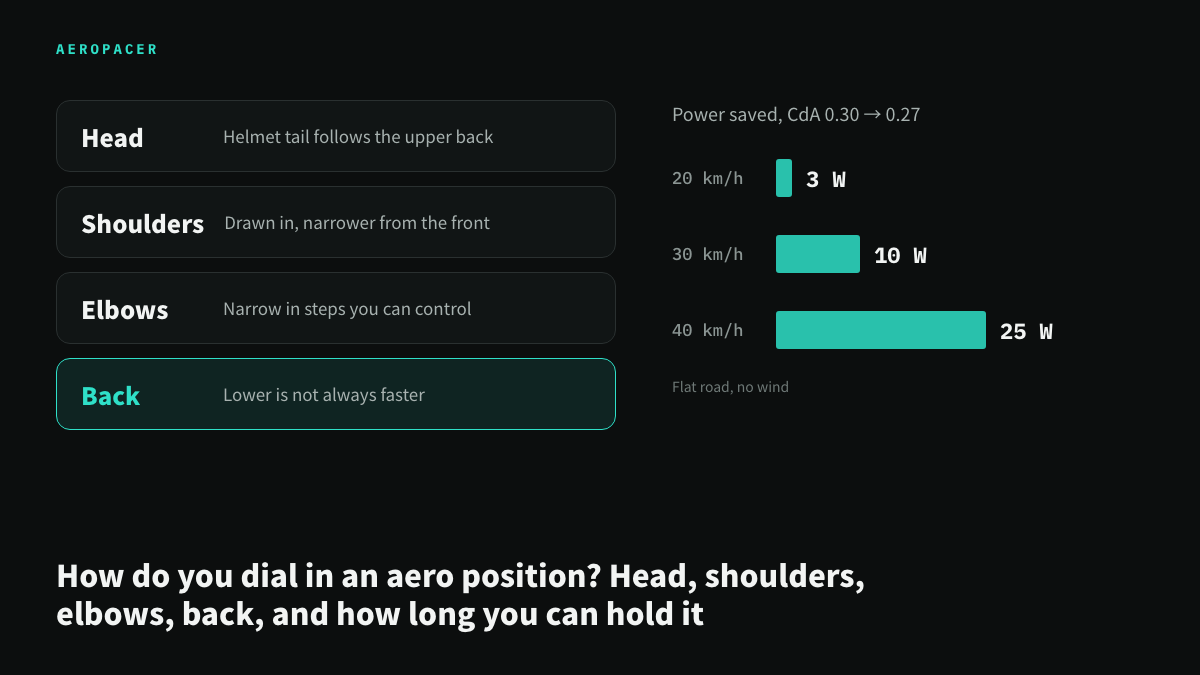
The power it takes to push air rises with the cube of speed, so the same 10% cut in CdA saves more the faster you ride. Here is the power saved by dropping CdA from 0.30 to 0.27 on a flat road with no wind:
| Speed | Power saved |
|---|---|
| 20 km/h | 3 W |
| 30 km/h | 10 W |
| 40 km/h | 25 W |
At 40 km/h you save 25 W. For someone who has been training for years, adding 25 W to FTP could take a whole season or longer. At 20 km/h you save only 3 W, which you will barely feel. If you race hilly courses with a lot of climbing, or your average speed is usually under 30 km/h, take care of your power and body weight first. The rest of this article can wait.
I covered what CdA is and how many minutes 0.01 is worth in What is CdA?, so here I will go straight to position.
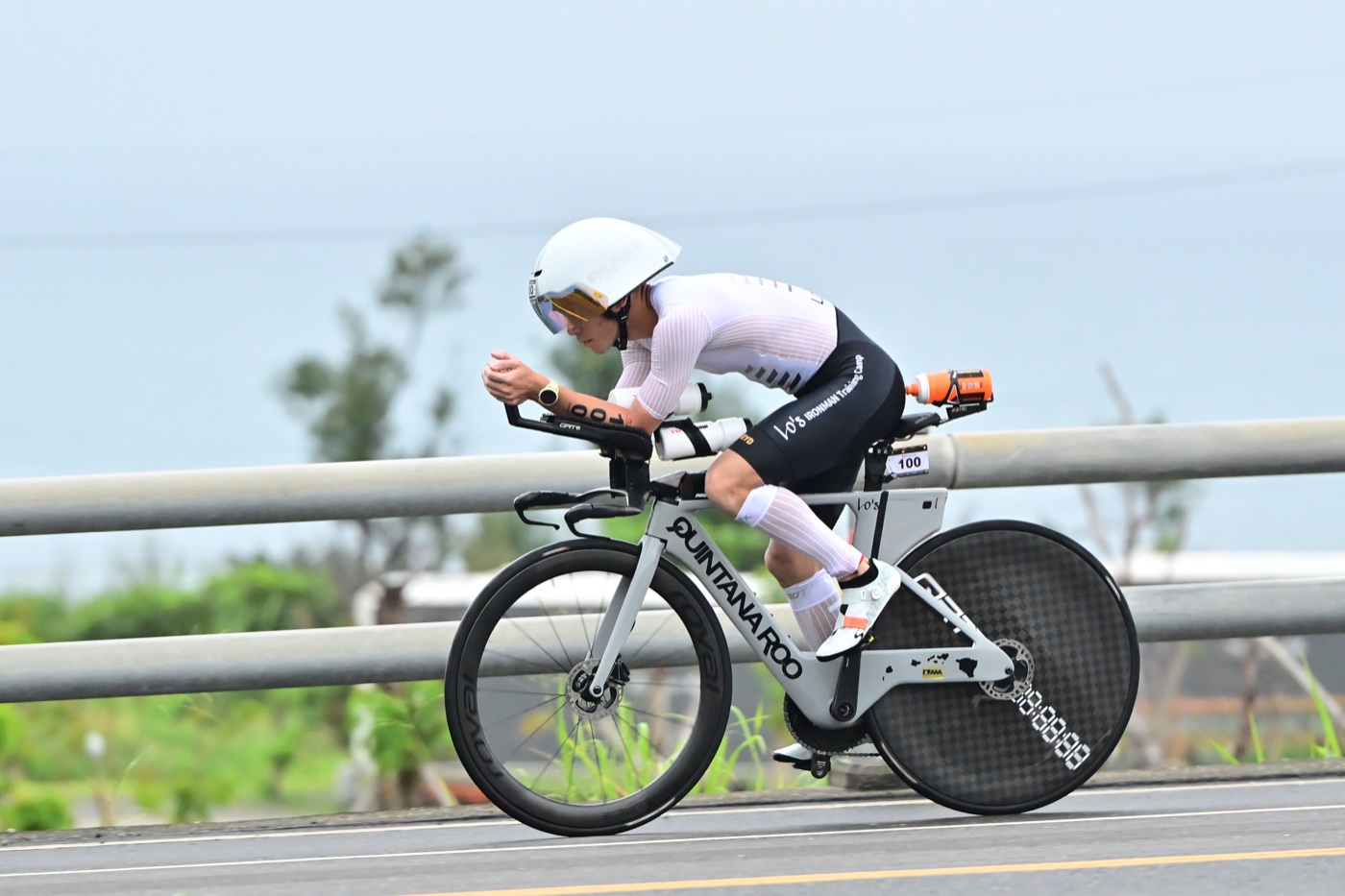
Head: line your helmet up with your back
Your head sits at the very front and top of you and the bike, and lifting it is like opening an umbrella. The most common case is getting tired, pushing the chin forward and staring straight down the road.
The fix is to pull your head back a little so the tail of the helmet follows the line of your upper back. Do not overdo it and stare at the stem either: the tail of the helmet sticks up, and you cannot see the road. This is why pros often wear their aero helmets high, with the brim just above the eyebrows. With the head tucked low, the helmet has to sit high for the eyes to see the road ahead.

Shoulders: make yourself narrower from the front
Look at a pro from the front and their shoulders seem squeezed inward, the whole upper body tucked into a small shape. The wider the wind sees you, the more drag you have.
Most age-groupers lack upper-body mobility, so their shoulders naturally splay out like an American-football linebacker. Drawing the shoulders in takes practice. Start on an indoor trainer in front of a mirror to find the feeling: shoulders slightly forward and in, upper back slightly rounded. Then slowly build up how long you can hold it.
Elbows: the easiest to adjust, and the easiest to overdo
Narrow the elbow pads on your aero bars and your frontal area shrinks with them. This is the easiest place in the whole position to make a change. Arm cups with higher edges lock your forearms in place, help you keep your shoulders drawn in, and make you feel more stable.

Bring the elbows in too far and the bike gets hard to handle. In a crosswind or on rough road you will want to come off the bars and back onto the base bar. Do that often enough over 180 km and you give back everything the narrower setup saved. So bring the elbows in a step at a time. After each step, do one or two long rides on roads you know, and only go narrower once you are sure you have control.
Back: lower is not always faster
Follow the logic above and a flatter, lower back should always be faster. In reality it is not that simple.
The flatter your back, the more closed your hip angle, so your thighs run into your stomach at the top of the stroke and your power drops. A 2020 lab study of 11 trained cyclists found that in the flattest upper-body position, threshold power was 16 W lower than in their usual position. In that study the lower drag still made up for those 16 W, but it was testing a short time trial. In a full distance (226), the bike leg takes five or six hours and there are 42 km to run afterwards. Whether you can hold the same angle that long, no one has yet tested over that kind of duration.

Aero is also very individual. Drop 2 cm lower and some people get faster while others see no difference. Everyone's body, bike and the way they meet the air are different. That is why you see some pros riding higher than others. It is not necessarily that they cannot handle the discomfort. Some of them have tested it and found that a bit higher is actually faster.
The fastest position is the one you can hold
A beautiful low position is not aero over a whole race if you have to sit up and stretch your back every ten minutes. What counts in a race is whether you can still stay down on the bars in the fourth and fifth hours, and whether your legs can still run once you are off the bike.

Pros did not start out that low either. It took years and thousands of hours for their bodies to get used to it. So position needs training, just like FTP: in your long rides, build up the time you spend on the aero bars a block at a time, and add mobility work for your hip flexors and thoracic spine plus core training. In the first few weeks on a new position, a sore neck and a tight lower back are normal. Let your body adapt first, then decide whether to go lower.
How do you know if the new position is faster?
Without a wind tunnel, you still have your power files. Once your head unit is linked, AeroPacer automatically calculates CdA for outdoor rides that are flat enough, steady enough and ridden solo (which rides get a number is covered in Your head unit is linked. Which rides actually get a CdA?). After you change position, there are three ways to compare:
- Ride several times before and after, then compare. A single ride is affected by that day's wind and road conditions. Build up several rides before and after the change, keep the route and equipment as similar as you can, and see whether the CdA trend goes down.
- Only use the stretch ridden in the new position. Select that stretch on the ride chart and CdA is calculated from that stretch alone, so the warm-up, city riding and traffic lights on either side do not get mixed in.
- Check whether the second half of a race comes out higher. Calculate the first and second halves of a race file separately. If the second half is a few percent higher than the first, it usually means you could not hold the position.
To see where your number falls, compare it with What is a good CdA?.
Next time you are three hours in, look at your shadow on the road again. Whether it is the same shape as when you started matters more than how low it is.